
The pump is part of a system
A drive motor turns the pump, which moves fluid into the hydraulic circuit. Valves route and regulate that flow. A cylinder creates linear movement; a hydraulic motor produces rotary movement. The fluid returns to the reservoir to circulate again.
The diagram explains the energy path. A working circuit also needs pressure protection, filtration and other components chosen for the machine.
INSIDE THE PUMP
Small chambers. Continuous flow.
Explore how changing chamber volume moves fluid through a vane pump.
As a chamber grows, fluid enters through the inlet. The available inlet conditions must allow the chamber to fill.
Relate rotation to flow ›Conceptual single-lobe illustration, not a Renowell product drawing. Balanced vane pumps use a different cam profile and port arrangement. Colors identify intake and delivery regions, not simulated pressure. Motion is slowed for learning.
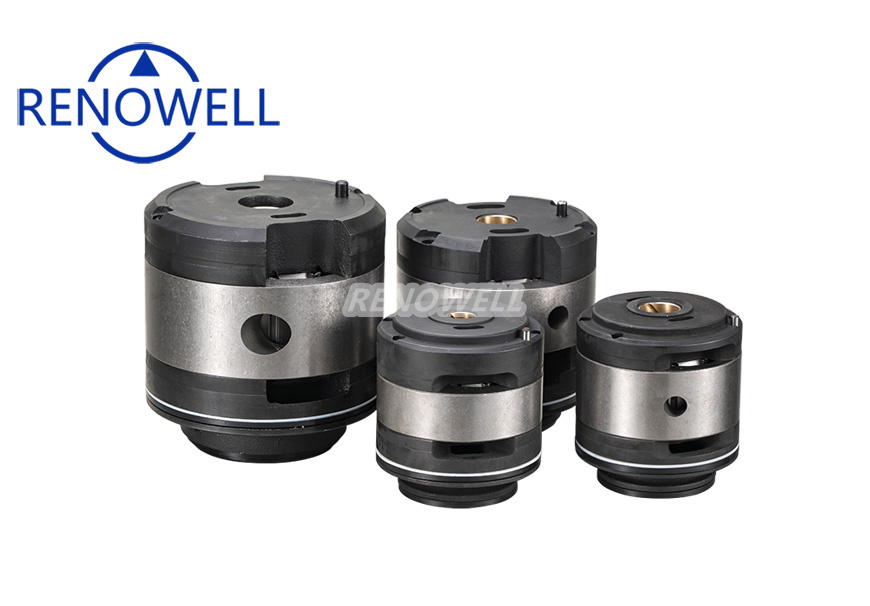
Explore the T6 / T7 single-pump series ›Pump: The pump moves fluid into the circuit. Displacement and shaft speed determine theoretical flow.
Conceptual energy path, not a hydraulic circuit schematic. Protective, filtration and cooling components are omitted. The reservoir returns fluid to the pump; the drive supplies mechanical power.
Flow and pressure do different jobs
Flow is the volume delivered over time. For a given cylinder area, more flow generally means faster movement. Pressure develops as the system encounters a resisting load. Cylinder force depends on pressure and effective piston area.
Buying a pump therefore involves both the required flow and the pressure rating. A larger pump is not automatically a better choice: the drive, valves, pipework and cooling arrangement must be considered together.
Start your inquiry with the machine
Describe the required movement, operating cycle and installation. Include the available drive speed and the fluid specification. For an existing system, supply the full pump code and equipment documentation rather than relying on appearance.
References & further reading
Bosch Rexroth — Hydraulics: compact knowledge ↗Parker — Hydraulic Pump Basics ↗For operating limits and service procedures, use the document for your exact pump and machine.